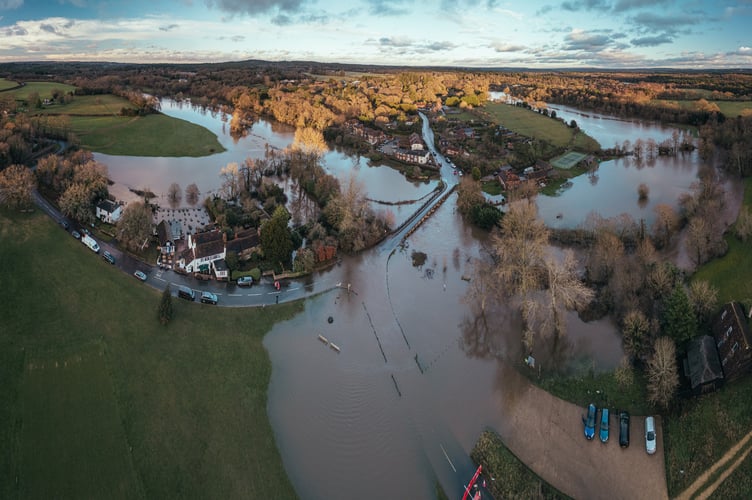
More than one in five flood defences in East Hampshire and Waverley are currently below the required condition as the region heads into another winter storm season, new figures from the BBC have revealed.
The statistics from the BBC Shared Data Unit show that in East Hampshire, 20 of the district’s 97 flood defences are below the standard set by the Environment Agency, 21 percent of the total. Of the 87 defences classed as “high consequence”, meaning they are designed to protect multiple homes or businesses, 17 are below the required condition, 20 percent.
In neighbouring Waverley, 26 of 111 flood defences are below standard, equating to 23 percent overall. Of the borough’s 96 high consequence defences, 19, again 20 percent, are below the required condition.
In nearby Hart District Council, the situation is more severe still, ranking the third worst in England. The district has 121 flood defences in total, with 50 currently below the required condition, a rate of 41 percent.



In Woking, the borough has 111 flood defences in total, with 28 currently below their required condition, 25 percent, placing it 17th worst in England.
Surrey Heath ranks ninth worst nationally, with 18 of its 56 defences below standard, 32 percent, while Rushmoor is 11th worst, with four of its 14 flood defences, 29 percent, below the required condition.
The district-level figures form part of a wider national picture that shows almost 8,500 flood defences across England are currently below their required condition as winter approaches.
As of October 20, 8.6 percent of the 98,466 flood defences inspected by the Environment Agency had fallen below their target standard. Around 6,500 of those are classed as high consequence, meaning failure could affect large numbers of homes or businesses.
Although the Department for Environment, Food and Rural Affairs says the overall condition of flood defences has improved since last year following record levels of investment, the BBC Shared Data Unit says stark disparities remain between different parts of the country. North Tyneside, Brentwood and Hart are among areas where more than 40 percent of defences are currently below standard.
Flood defences are not the responsibility of district councils. They are owned and maintained by a variety of organisations, including private individuals, water companies, charities and local authorities, but just over half nationwide are maintained by the Environment Agency, which routinely inspects and grades them. Assets are rated on a scale from one, very good, to five, very poor. A defence is classed as Below Required Condition if it falls short of the minimum standard set for it.
The figures come as the country braces for another winter of extreme weather. Last winter saw six named storms, with severe flooding during November 2024. The Met Office has warned that winters are becoming wetter, with six of the 10 wettest winter half-years on record occurring since 2000.
In April, Floods Minister Emma Hardy told MPs that 3,000 of the Environment Agency’s 38,000 high consequence assets were in the “poorest condition on record” following years of under-investment. The Agency’s own target is for no more than two percent of its high consequence defences to be below standard. The current national figure is now close to nine percent.
Flooding expert Professor Hannah Cloke, of the University of Reading, said some of the local figures were deeply concerning.
“All it would take would be a large storm to come through, or a series of storms that we've seen before, and then these assets would fail and there would be a massive problem,” she said.
The Government has pledged £2.65 billion over two years to build and restore more than 1,000 flood defences across England. However, experts say the scale of the maintenance challenge, combined with a changing climate, means significant pressure will remain on flood protection systems for years to come.
An Environment Agency spokesperson said: "Protecting communities in England from the devastating impact of flooding is a top priority - which is more important than ever as climate change brings more extreme weather.
"Each year, we complete up to 165,000 inspections of flood assets across the country and have recently redirected £108 million into repairs and maintenance. This will help to ensure the strongest protection for nearby communities.
"If the performance of an asset is reduced, then immediate action is taken to ensure that flood risk continues to be effectively managed until the asset is fully repaired or replaced."
Comments
This article has no comments yet. Be the first to leave a comment.