
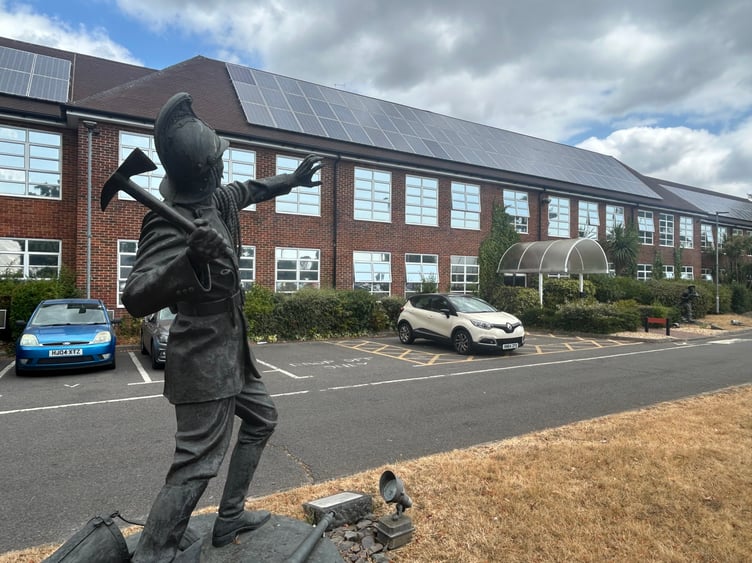
A Farnham business has helped Hampshire & Isle of Wight Fire and Rescue Service develop plans to cut energy bills and carbon emissions across its 62 buildings.
Building performance specialist Mesh assessed the fire service's headquarters in Eastleigh and six different types of fire station to identify opportunities to improve energy efficiency.
The project examined buildings of different ages and construction types, including parts of the headquarters dating back to the 1930s.
Mesh analysed energy consumption, heating systems and insulation to identify improvements that could reduce running costs and support the service's net zero ambitions.
One option explored was replacing traditional heating systems with air source heat pumps, which could reduce energy consumption for space heating by around 50 percent.
However, the assessments also highlighted the cost and disruption involved in adapting older buildings.
Mesh therefore investigated a hybrid approach, using heat pumps for most heating requirements while retaining gas boilers during particularly cold weather.
Doug Johnson, founding director of Mesh, said: “Public sector estates often include buildings of varying ages, construction types and patterns of use, so there is rarely a single solution for improving energy performance, reducing carbon emissions and maintaining a comfortable working environment for occupants as the climate changes.
“This project demonstrates the value of understanding how individual buildings actually perform before deciding where to invest.”
Carrie Dickson, energy and sustainability officer at Hampshire & Isle of Wight Fire and Rescue Service, said: “Our aim with this project was to optimise the energy performance of each building and to apply those learnings to our wider estate across Hampshire and the Isle of Wight.
 Letters to the editor: Farnham's Castle Street planters fail the Craft Town test
 Luis Guembes murder trial hears teenager deny video confession to fatal stabbing
 Greg Stafford MP: Has the Budget put welfare before defence and growth?
 Jury shown new measurements of fatal stabbing scene in Luis Guembes trial
“We now have the evidence-based analysis needed to understand which buildings perform well and where improvements and technical adjustments should be targeted to reduce energy consumption.”
The findings will also help inform future building projects and refurbishments.
Comments
We've recently changed our login process. If you have an account for commenting, you will need to re-register on the login window.
This article has no comments yet. Be the first to leave a comment.