
At 11.40 at night, the air-raid siren started.
My daughter Lina was asleep. It was her birthday the next day. We were staying in Kyiv, and within minutes our phones were warning of ballistic missiles.
Unlike drones, which can sometimes be tracked for a long time as they cross the country, ballistic missiles give you almost no time.
We moved into the corridor, where two walls separated us from the outside.
Two minutes later came the explosions. The Russian attack continued until 1.30am.
The building shook. Doors and windows moved in their frames. Lina told me she was frightened, so I lay over her and covered her with my body.
I knew perfectly well that if a ballistic missile hit our building, my body would not protect her. It was something a mother does because there is nothing else she can do.
There were more explosions, then silence, then explosions again.
Eventually, the all-clear sounded.

I leaned towards Lina and whispered: “Happy Birthday.”
That was part of our summer holiday.
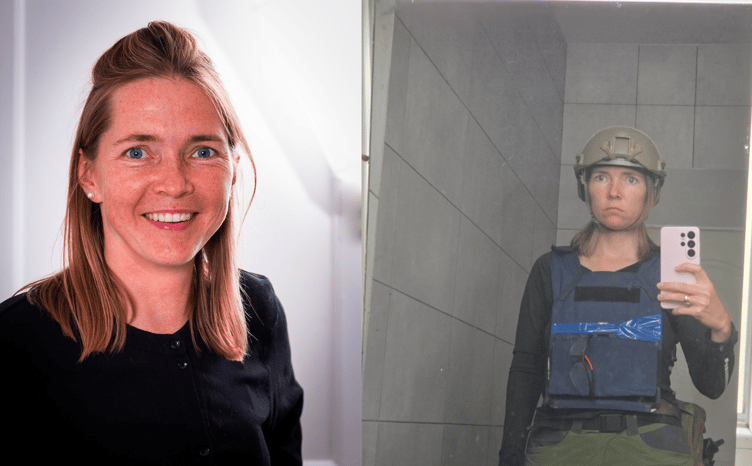
I am a Ukrainian journalist and photo correspondent, but since Russia’s full-scale invasion I have lived with my children in Surrey, where I now work as a photographer.
Ukraine, however, has never stopped being home.
This summer we returned again, first to Kyiv and then, for me, further east to Zaporizhzhia, a frontline city.
Coming back to Ukraine produces a strange feeling. Life looks normal until suddenly it does not.
People drink coffee. Children meet their friends. Couples walk through parks. Shops are open. Flowers are sold on street corners.
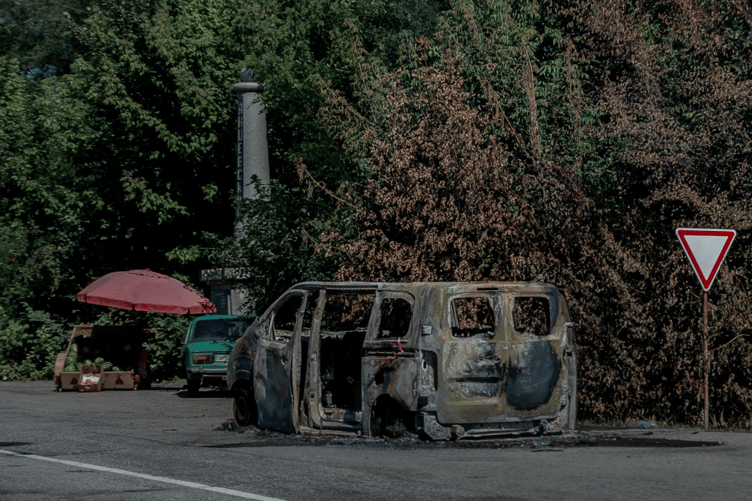
Then an air-raid warning appears on your phone and everybody calculates the risk: shelter, corridor, underground station – or carry on with whatever you were doing.
War has entered ordinary life so deeply that people can discuss missiles in the same tone they might once have discussed the weather.
From Kyiv, I travelled to Zaporizhzhia.
The closer you move towards the front, the more the war changes from something announced on your phone into something physically present around you.
This was where I spent part of my summer working as a photographer.
One of the people I spent time with was my colleague Dmytro, a correspondent who continues to report from the city and the surrounding war zone.
His work means going towards the places most people are trying to escape from.
Watching Dmytro work reminded me how important local journalists are. International reporters may arrive when a major attack makes the headlines, but correspondents like him remain there afterwards.
They continue telling the story when the world’s attention has moved somewhere else.
But what kept drawing my camera were not the destroyed buildings.
It was the people.
One of them was Oleksandr Shkalikov.
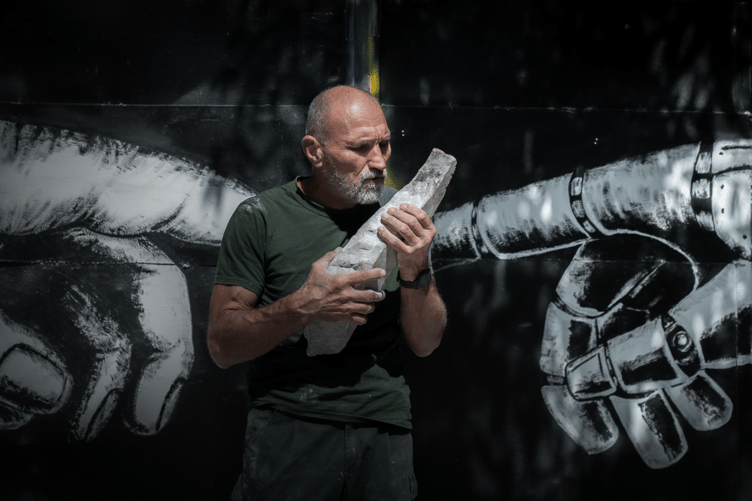
For decades, Oleksandr had been a sculptor. His hands worked with stone, wood and clay.
Then Russia invaded.
In 2022, aged 56, he joined Ukraine’s National Guard and became a tank soldier. His tank was among those advancing towards Russian positions during the war.
Now he is back in Zaporizhzhia, leading the regional branch of the National Union of Artists of Ukraine and making sculpture again.
This summer, he was working alongside other Ukrainian artists, creating monumental sculptures in a city living under the regular threat of Russian attack.
I kept thinking about his hands.
Hands that once shaped stone.
Then operated a tank.
Now making art again.
What happens to a country’s artists during a long war?
They continue creating art.
Another man I photographed was a Ukrainian serviceman who, before the war, had never owned a horse.
He saw an advertisement from a local horse farm. The owners could no longer afford to keep one of their animals and were preparing to send the horse for slaughter.
He bought her.
Now, whenever his military duties allow, he comes to see her.
In the middle of war, this horse has become a place of peace for him.
He saved her life, but watching them together, it was difficult not to think that she was saving something in him too.
The horse lives at the Family Horse Club in Zaporizhzhia, run by 29-year-old Yevheniia Yermakova.
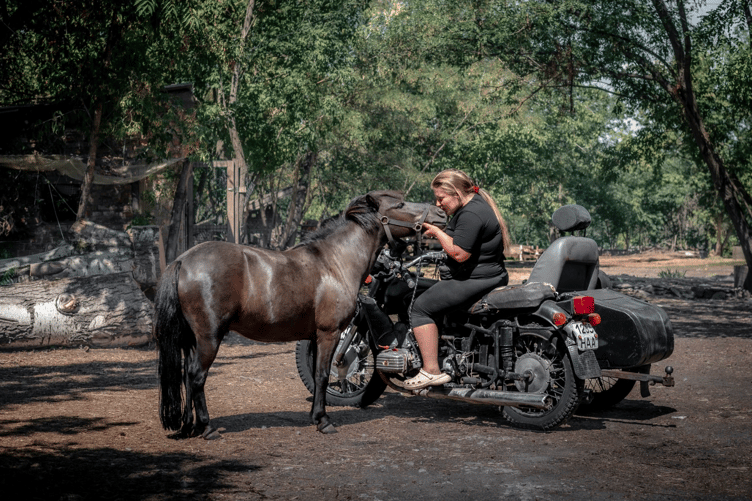
Yevheniia opened the equestrian sports school before the war, but since Russia’s full-scale invasion it has also become a refuge for animals evacuated from areas affected by Russian attacks.
Today, she cares for 28 horses, including 10 evacuated from other parts of the Zaporizhzhia region.
The club is also home to goats, sheep, pigs, chickens, ducks, dogs, rabbits and parrots.
In June 2026, the club was hit by a Russian guided aerial bomb.
Three horses were killed and others were wounded. Some of the surviving animals still carry shrapnel in their bodies.
“It is hard, very hard now. Here, you are responsible not only for yourself, but also for feeding the animals. They don’t understand that there is a war,” Yevheniia says.
Then there was Vitalii.
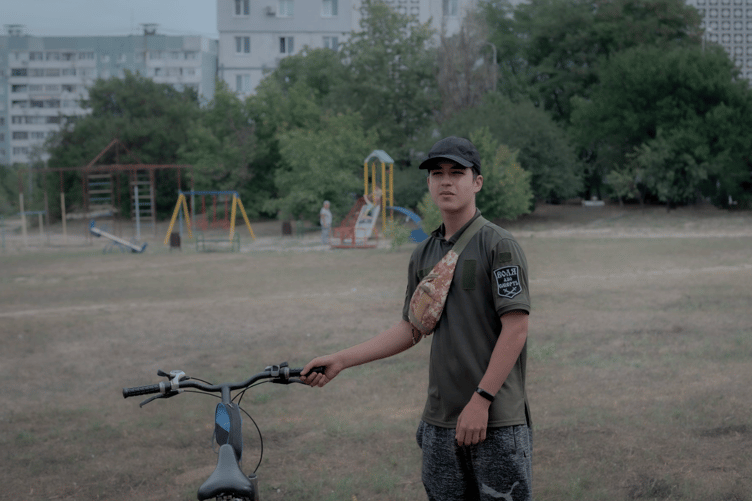
He is 15.
When I photographed him, he was wearing the military shirt of his older brother, who was killed in the war.
On it was a patch carrying the words “Freedom or Death”.
Vitalii was only 11 when the full-scale invasion began.
Now he talks about entering military school.
Children in Ukraine have grown up very quickly.
There are moments when, as a photographer, you instinctively raise the camera.
And there are moments when you hesitate because you suddenly see your own children in the person standing in front of you.
That boundary has become increasingly difficult for me.
For years, I have photographed what the war was doing to Ukrainian families.
I am still a journalist. When something happens, part of my mind automatically begins recording details: the time, the place, the light, people’s names, what they said.
But I am also a wife and a mother.
Sometimes those two roles sit very uncomfortably together.
I also spent a day with Oksana, a volunteer who supports hospitals and soldiers, as well as civilians who are unable, or unwilling, to leave their homes close to the fighting.
Our day began at the hospital and then at her warehouses in Zaporizhzhia, collecting supplies.
From there, we drove further towards the villages, taking food and other essentials to people who still live close to the frontline.
At one point, we came under the threat of FPV drones.
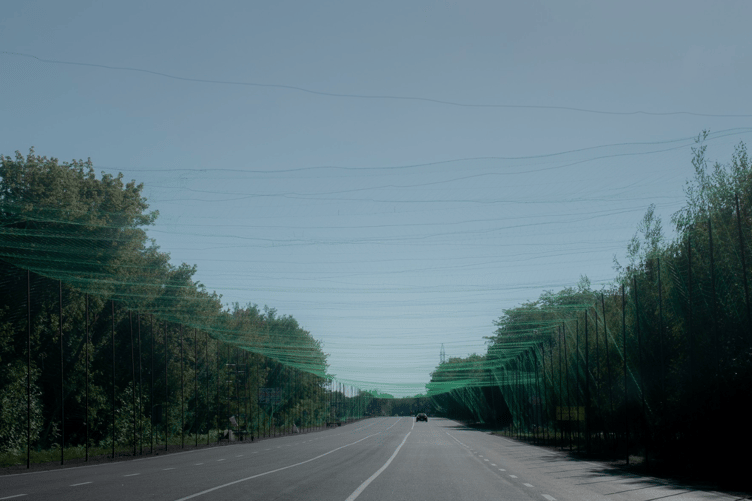
Across the city, anti-FPV drone nets now cover roads, hospitals and petrol stations. But there is no way to protect everything.
We hid first under a tree and then inside a warehouse, listening and waiting.
In moments like this, everything suddenly becomes very simple.
You understand how vulnerable you are. How little control you have. And how precious the life you already have really is.
You stop thinking about small problems. You think only about surviving. We should survive. We should.
And then, when the immediate danger passes, you continue.
That is what Oksana does.
She goes back to loading supplies, checking what people need and driving towards places where others are trying to get away from.
For her, helping people and soldiers near the frontline has become part of everyday life.
People often ask why Ukrainians remain in cities like Zaporizhzhia.
After spending time there, I think the answer is both complicated and extremely simple.
Home.
It is the elderly woman who refuses to leave the street where she has lived all her life.
The artists carving stone while air-raid sirens sound. The soldier travelling to see the horse he rescued.
Families looking after animals that cannot evacuate themselves.
Teenagers carrying the memory of brothers and fathers who have been killed. War is everywhere, but so is the determination to continue living. Perhaps that was the most important thing I photographed this summer.
Not war itself, but the life that stubbornly continues beside it.
Comments
We've recently changed our login process. If you have an account for commenting, you will need to re-register on the login window.
This article has no comments yet. Be the first to leave a comment.