
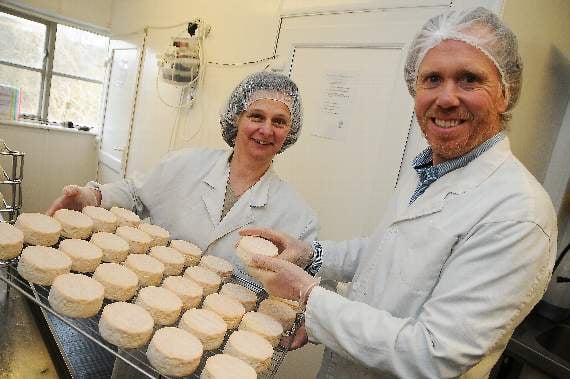
HUSBAND and wife team Pam and Francis Gimblett are planning to scale up the production of their soft cheese Floyd from 100 cheeses a week by 10 times over the next 18 months.
Currently produced in their converted double garage in Grayswood, the recipe has been perfected over three years and has proved popular, with the stock selling out every time the pair set up stall at local farmers’ markets.
Francis had already built up a reputation as a wine expert and the couple set up Taste of the Vine in 1997, hosting wine, real ale and cheese events, and championing locally produced food.
Trading under the name of The Gimblett Cheese Company, they were inspired to become artisan cheese makers after a “cheese tour” of Normandy in 2013, an area which has a long tradition of small scale producers. They took a cheesemaking course in this country, then preparations began and the garage became a micro diary.

.jpeg?width=209&height=140&crop=209:145,smart&quality=75)


The washed-rind cheese initially launched at the monthly Haslemere Farmers’ Market and is now also sold through third parties at The Cheese Stall market pitches in Hampshire, the Haslemere Cellar in West Street, and Cowdray Farm Shop in Midhurst.
The next stage will be to sell through more local retailers and perhaps wholesale into the London marketplace, the cheesemaking production moving into larger premises.
Pam and Francis are just one of two cheesemakers in Surrey – the other is at Norbury Park Farm, near Dorking, producing mainly a blue, crumbly textured cheese – however cow’s milk is the only thing they have in common. The milk for Floyd comes from the Jersey herd at Pierrepont Farm, Frensham and is whole and unpasteurised, giving the cheese a mild yet rich, creamy flavour.
Both the flavour and texture can be described as somewhere between Camembert and Brie, although Francis said: “It’s not a Brie, it’s not a Camembert, it’s a Haslemere, our own recipe”.
The cheese can be enjoyed either “young” as it is sold at three to four weeks, or “mature”. After keeping it for a further two to three weeks in a closed container in the fridge – so it does not dry out – it becomes richer developing mushroom and nut flavours.
Francis described the production process which involves several stages.
The milk arrives chilled in churns and is then brought up to blood temperature – the temperature that bacteria is most happy at –– then cultures are added to “create the style and flavour” he is looking to get.
Rennet is added to set the curd. After an hour, the curds are chopped into small cubes, drained and put into the individual cheese molds.
At this stage, which lasts for around 18 hours, each mold is frequently turned for an even moisture distribution inside the individual cheeses.
Salt is then added, which helps to form the rind and gives protection from any unwanted microbes.
The molds then go into a “hastening room” for three or four days, at a lower temperature (18 degrees Centigrade), which helps the beneficial cultures and bacteria to establish. The cheeses are then moved to another room, at 11 degrees C, where the rind is washed with “a few nips” of English milk vodka and brine, which gives it a faint pink colour.
Disappointingly perhaps, this does not add any further flavour or even alcohol to the cheese, but wards off any unwanted moulds.
The finished cheese is refrigerated at five degrees; the whole churn-to-cheese process taking four weeks.
Comments
This article has no comments yet. Be the first to leave a comment.