
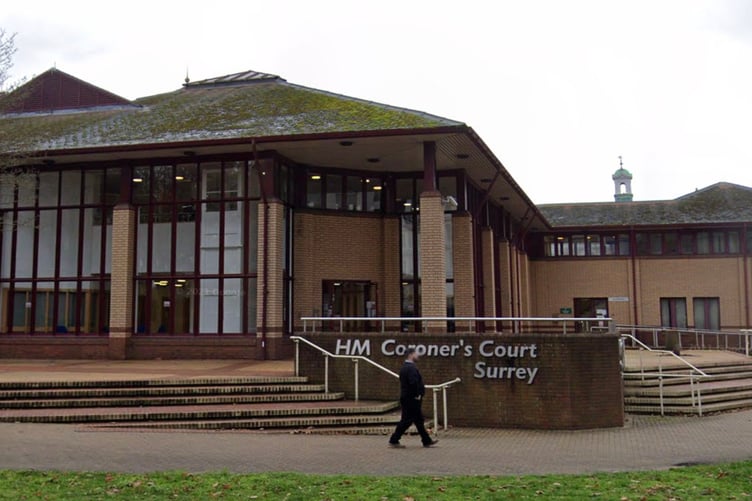
At a pre-inquest review today (February 23), Surrey’s senior coroner Richard Travers said he would take “a couple of weeks” to rule on a Surrey Police application for anonymity for the firearms officers who shot 29-year-old Joel Stenning.
Mr Stenning died after being shot in the early hours of August 11, 2024, in Nursery Road, Knaphill, near Woking.
He had reportedly pointed an air rifle at officers who were called to his home following reports of a man with a gun. Mr Stenning died shortly after 7.30am on August 15 in a London hospital from “complications of a gunshot wound to the abdomen”.




Mr Stenning was born in Chertsey, lived in Woking and worked as a roofer. He was remembered by the coroner, who opened proceedings by offering condolences to his parents, who were present in court.
Surrey Police, backed by the Chief Constable, applied for nine firearms officers to remain unnamed. Chief Superintendent (CSI) Justin Berkenshaw told the court that firearms officers are highly trained, voluntary specialists who deal with the “most dangerous and lethal criminals”.
Naming them, he argued, could put them and their families at risk from organised crime groups and damage future careers.
“If someone gets named it cannot be undone,” he said, adding that officers have faced threats and harassment in other cases nationally. He said anonymity would help officers give their “best evidence” without fear of becoming headlines.
BBC Surrey said that giving evidence is stressful for everyone in court and, given the circumstances, would expect police officers to give the best evidence possible.
CSI Berkenshaw said, due to the specialist and technical nature of highly-trained armed police officers, they are not easily replaced. He raised concerns that if the officers’ names were put into the public domain, not only could it undermine their role as armed officers, it could discourage new recruits from going into armed operations and persuade current officers to give up their weapons.
CSI Berkenshaw said: “My team works extremely hard with my firearms officers to prevent knowledge of their role…this is because of the risk to the officers and their families..and to maintain an effective firearms unit.”
He said he was worried naming the officers could risk Surrey Police’s capability for an armed officer unit.
But lawyers for the Stenning family and BBC Surrey (on behalf of the media) opposed the move. The family’s representative said there was no evidence of any threat linked to Mr Stenning’s relatives or associates and warned against a “blanket” approach simply because officers were armed.
They argued open justice should not be side-lined by general policy concerns.
The family’s legal representative said: “It sets an entirely new precedent setting approach in which the mere fact of the status of a firearms officer should give rise to anonymity across the board without assessment of conditions of the case.”
Mr Travers noted the force’s arguments were not specific to this case but could apply to any firearms incident. He will now weigh privacy and safety concerns against the principle of open justice before deciding whether the officers will be named when the full inquest begins.
The inquest, expected to be heard over four weeks in early 2027, will examine the circumstances surrounding Mr Stenning’s death.
Comments
We've recently changed our login process. If you have an account for commenting, you will need to re-register on the login window.
This article has no comments yet. Be the first to leave a comment.