
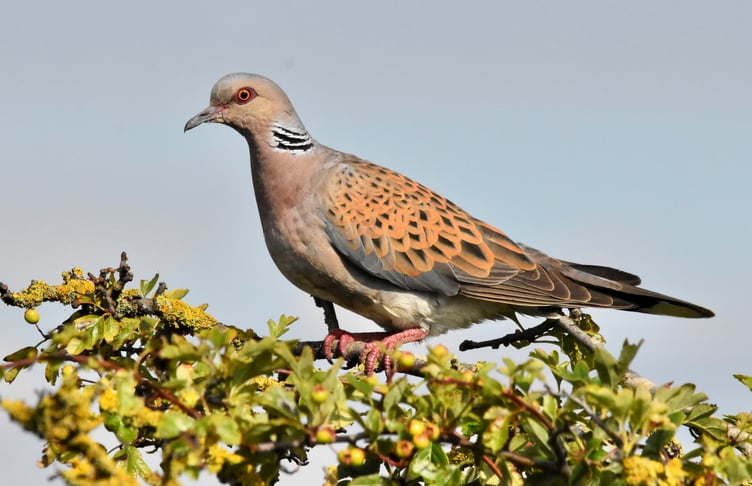
The turtle dove may be best known as a Christmas gift, but a project near Selborne is hoping to ensure the much-loved bird has a future in the Hampshire countryside.
Thirty turtle doves were released at an undisclosed location in the South Downs National Park in late spring, as part of an ambitious effort to reverse the species’ dramatic decline.
The birds have already begun settling into their new surroundings, with sightings of them flying around the area, making their distinctive churring calls and laying eggs.
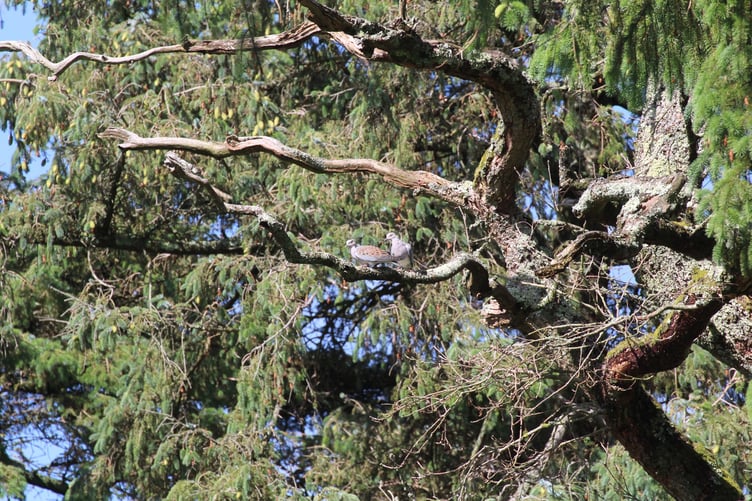
It is hoped they will return next spring after completing their extraordinary 3,000-mile migration to sub-Saharan Africa, travelling through France, Spain and Morocco.
The project is being led by the Selborne Landscape Partnership, a group of farmers and landowners working to improve the local landscape and wildlife, alongside the South Downs National Park Authority, the Farming and Wildlife Advisory Group for the south east and the Turtle Dove Trust.
The release took place in the countryside once explored by the celebrated naturalist Gilbert White, who lived in Selborne.
Turtle doves were once a familiar sight across the South Downs, but their numbers in the UK fell by 98 per cent between their peak in the late 1960s and 2023. Habitat loss, predation and hunting have all contributed to the decline.
Paul Bushell, a ranger for the South Downs National Park, said: “We all know the turtle dove from the festive carol, but the truth is they are now far too rare for such a Christmas gift.


“This stunning, colourful bird would once have been fairly common across the South Downs landscape. However, they are now one of the fastest-declining bird species in Europe due to habitat loss, predation and hunting, with numbers plummeting by 98 per cent in the UK between their peak in the late 1960s and 2023.
“There are still small numbers of turtle doves living in the National Park and we hope that careful releases like this can help create a new and much-needed South Downs stronghold for this red-listed bird.”
The western side of the National Park is particularly suitable for the farmland species, which favours woodland edges, arable fields, scrubby hedgerows and nearby ponds.
To help the birds flourish, farmers and landowners have planted wildflowers that provide food, including fumitory, birds-foot trefoil, vetch and red and white clover. Seven ponds were restored last winter, with another 14 due to be restored this autumn.
The birds need accessible, shallow freshwater for drinking and bathing close to their nesting sites.
Mr Bushell said the released birds appeared to be doing well, with members of the wider community helping to monitor their movements by sending in sightings.
“Interestingly, one of the females has come back into the enclosure to lay some eggs, which is incredibly encouraging,” he said.
“They really are a spectacularly beautiful bird and the males produce the most enchanting churring sound during the breeding season. It is such an incredible and moving experience to see and hear the birds back in the landscape where they belong.”
Plans are already being made for a further release in spring 2027. Around 100 turtle doves are currently being cared for in an enclosure by the landowner and a team of volunteers.
The landowner, who wishes to remain anonymous, said the project was motivated by concern for declining bird populations and the wider natural environment.
“It saddens me to see where we have habitat loss and dwindling numbers but with the local group of farmers, we are restoring the habitat for wildlife to flourish and I would do it again, for any of these species that belong in the UK environment,” they said.
“Sparrows and starlings are also all equally important but the beautiful turtle doves have been in shocking decline and we want to bring them back from the brink.”
William Selborne, chair of the Selborne Landscape Partnership, said: “We are delighted to have been able to host this project and it is wonderful to hear this iconic bird back in the Selborne landscape after so long an absence.”
Robert Anderson-Brown, trustee of the Turtle Dove Trust, said the charity’s mission was to help the drastically reduced UK population recover through carefully reared captive-bred birds.
He added: “The Turtle Dove Trust have been working in partnership with the SDNPA, Selborne Landscape Partnership, FWAG SE amongst several other landowners and organisations to help support this innovative project and to help save this wonderful bird from potential extinction in the UK.”
Despite their association with the Twelve Days of Christmas, turtle doves are summer visitors to Britain, generally arriving in mid-April and departing by the end of August or early September.
The species is smaller and darker than the familiar collared dove, with distinctive chestnut-and-black mottled upperparts and a black tail edged in white.
The National Park Authority says the project forms part of its wider ReNature campaign to restore habitats and help wildlife recover across the South Downs.
Comments
This article has no comments yet. Be the first to leave a comment.