
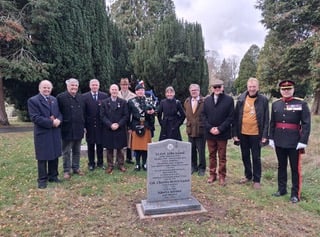
A Waterloo veteran who helped establish Farnham’s art school has finally had his grave marked with a memorial more than 150 years after his death.
Lieutenant Colonel John Luard was a soldier, artist and author who fought in the Napoleonic Wars before helping to lay the foundations of Farnham’s creative heritage.
However, his final resting place had remained unmarked for years until members of the Waterloo Association intervened.
The project began when one of Luard’s descendants, James Luard, contacted the association with a collection of family documents and artwork.
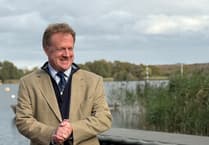
Phil Buckley, who leads the Waterloo Association’s memorial restoration and maintenance work, said: “In this case my colleague, Gareth Glover, was contacted by a James Luard who lives in Somerset, who had a load of letters, paintings and drawings from John Luard.
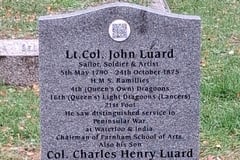
“One of the things we did was to find his last resting place, which is Farnham.”
Working with Farnham Town Council’s cemetery team, the association identified the grave and, on discovering it was unmarked, made arrangements for a memorial to be installed.
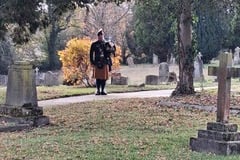
An unveiling ceremony was held last week, attended by the Mayor of Farnham, military representatives and members of the Luard family.
Mr Buckley said: “We had a nice little party, there were only about 10 of us. The town mayor came along, as well as our chairman who’s a retired general. We had a piper from the Queen’s Royal Hussars and a former commanding officer of the 16th Lancers.


“We also had someone from the Battlefield Trust and the Luard family members, Caroline and Frank.”
Born in 1790, Luard initially served in the Royal Navy before joining the Army and fighting in the Peninsular War, earning the Military General Service Medal.
He later served with the 16th Light Dragoons at the Battle of Waterloo in 1815.
While Luard’s military career may not have made him a household name, Mr Buckley said his story was representative of thousands of soldiers who served during the Napoleonic Wars.
He said: “The story isn’t of particular note, but he represents the thousands of people who served in wars. And the Napoleonic Wars 200 years ago were massively significant, it was effectively a world war.”
What distinguished Luard from many of his fellow soldiers was his artistic ability.
His sketches and illustrations documented military life and landscapes overseas, providing a valuable historical record of the era.
His published works included Views in India, St Helena and Car Nicobar in 1835 and History of the Dress of the British Soldier in 1852.
However, it was in Farnham that Luard arguably left his greatest legacy.
In April 1871, he chaired the meeting that led to the establishment of Farnham School of Art, the forerunner of today’s University for the Creative Arts (UCA).
Mr Buckley said: “These old soldiers are not just people from a war 200 years ago.”
He added: “They’re people who have done a lot for their country and continue to do quite a lot.”
Luard died in October 1875, aged 85. Last year, a plaque was unveiled on Farnham’s Notable Names wall in South Street to mark the 150th anniversary of his death.
The installation of a gravestone is the latest step in ensuring his contribution to the town is remembered by future generations.
Mr Buckley said: “I think it's about continuity. You’re making sure they’re not forgotten. By putting a gravestone on his grave, you’re signposting future generations to know about him or to go and find out more.
“They are hardworking, loyal and usually exceptional people. These gravestones are signposts to the past, but also help people in the future who want to uncover this story again.
“I think it's about maintaining tradition. It's about maintaining a memory and helping people in the future to learn and discover these people again in say another 200 years.”
Comments
We've recently changed our login process. If you have an account for commenting, you will need to re-register on the login window.
This article has no comments yet. Be the first to leave a comment.