
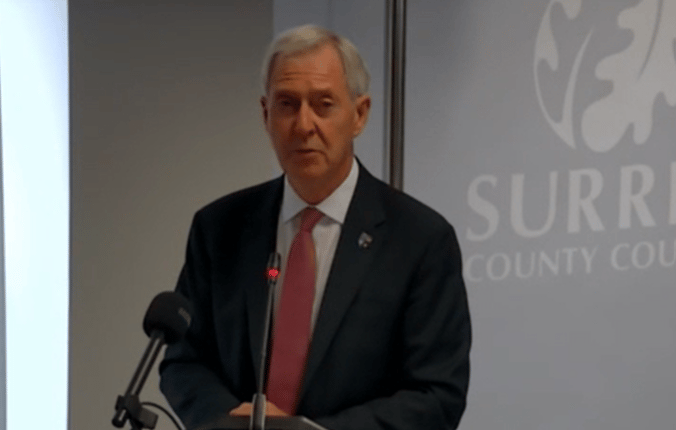
Surrey County Council’s leader says he expects Andy Burnham to “turbocharge” initiatives that could see the county get its own elected mayor.
Speaking at a meeting of the full council, Councillor Tim Oliver said he “fully expects” the incoming Prime Minister to lean hard into devolution of powers to England’s regions.
Councillor Oliver is serving a final stint in office before the county council he leads is abolished along with Surrey’s 11 district councils.
These will be replaced next April by two unitary councils in East Surrey and West Surrey, each of which will be responsible for all local government services in their respective areas.
But Councillor Oliver expressed his hope these reforms will go one step further, leading to the creation of an overarching elected mayor for all of Surrey.
He said he is “pleased to see” progress being made towards the establishment of a foundation strategic authority (FSA) – a county-wide body that would serve as a stepping stone towards a new mayoralty.
Councillor Oliver said: “Having seen the Secretary of State last week at the LGA (Local Government Association) conference, I know it is his hope to establish that FSA here in Surrey.
“And I’m confident that will lay the ground for a directly elected mayor of Surrey in the near future.”
Former Greater Manchester Mayor Andy Burnham, who was elected as MP for Makerfield last month, is widely expected to succeed Keir Starmer as Prime Minister next week.
Mr Burnham has championed greater devolution of powers to regional governments across Britain, which is set to be a signature part of his policy programme.
.png?width=209&height=140&crop=209:145,smart&quality=75)
He served for nine years at the head of Greater Manchester’s combined authority, a body that brings together the region’s 10 boroughs under one directly elected mayor.
Councillor Oliver said he hopes Mr Burnham’s experience as a regional mayor will inspire him to roll out further devolved powers and new mayoral authorities.
He said: “I fully expect our incoming Prime Minister to turbocharge that devolution agenda, having seen first hand the benefits of a mayoral system – and with change, growth, and improvements in local services that can be delivered.”
The abolition of Surrey County Council comes as part of a wider local government reorganisation, which is seeing mergers in many “two-tier” authorities where there are separate county and district councils.
Areas with this two-tier structure have local government responsibilities split between these two types of council, while newer unitary authorities oversee all services.
Councillor Oliver said he believes Surrey County Council officers and councillors have “a record to be proud of”.
“We said we would make Surrey fit for the future, and we have done just that,” he added.
“Over recent years, many councils across the country have struggled, and Surrey has met those challenges head-on and thrived.
“Our finances have been transformed to a point where we have a stable, balanced budget, even in the face of extreme pressures.”
Elections were held for the West Surrey and East Surrey “shadow authorities” in May, which will work to get the new councils up and running in time for the handover of power in April 2027.
Councillor Oliver previously told the Local Democracy Reporting Service (LDRS) it is his “expectation” that Surrey could be ready for mayoral elections in 2028, alongside four other new combined authorities.
However, this would depend on the green light for its creation being given by central government.
Comments
We've recently changed our login process. If you have an account for commenting, you will need to re-register on the login window.
This article has no comments yet. Be the first to leave a comment.