
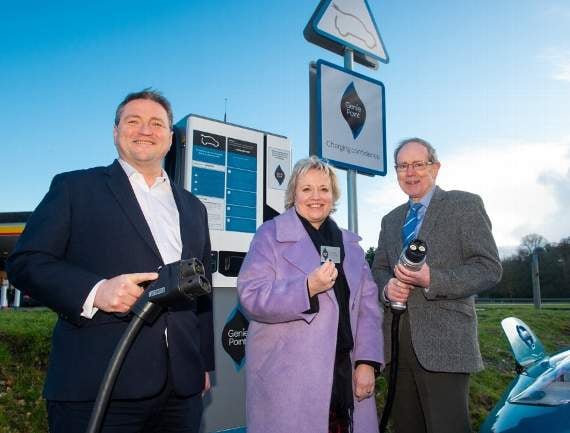
WAVERLEY has been found to have the second fewest charging locations per 1,000 electric vehicles of all UK local authorities, according to BBC analysis of government data.
The revelation that the borough has just five electric car charging points serving 571 licensed fully electric or plug-in hybrid cars, LGVs and quadricycles, comes despite the council’s awareness of excessive levels of nitrogen dioxide in Waverley since 2004.
Waverley has been duty-bound to submit an annual report to DEFRA after an air quality management area was declared in Farnham in 2004, following the discovery of excessive levels of NO2 – which is linked to as many as 40,000 premature deaths every year in the UK.
However, the council has in the past been criticised by councillors and air quality experts for a lack of action on the issue, and has seemingly fallen behind other UK authorities in preparing for a life after carbon fuels.
 Peeps into the Past: When Farnham welcomed refugees of war
 Dream of a white Christmas denied in Surrey and Hampshire
 Rise in hospital admissions for stress and anxiety in east Berkshire, north east Hampshire, Farnham and Surrey Heath
 Peeps into the Past: Castaway Christmas for Tilford's own Robinson Crusoe
Vehicle emissions are one of the biggest contributors to air pollution and climate change and so the government is pushing towards a revolutionary change in how we travel by encouraging drivers to opt for an ultra-low or zero emission vehicle.
But while a large number of charging stations are installed privately, the government has been encouraging businesses, home owners and local authorities to install more charging points through various grants and schemes.
Not every local authority has been preparing for the rise in electric and plug-in hybrid vehicles, though. Only 28 have taken advantage of the government’s £2.5m funding pot for the On-street Residential Chargepoint Scheme, which aims to help drivers to charge their vehicle – the nearest being Portsmouth City Council.
Last year, some 46,000 electric vehicles were registered for the first time and the government’s target is for at least half of new cars to be ultra-low emission by 2030.
Comments
This article has no comments yet. Be the first to leave a comment.