
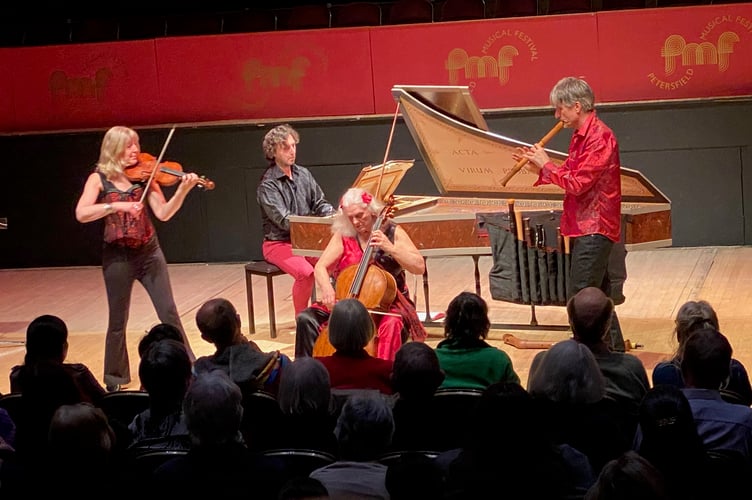
Baroque collective Red Priest was greeted with extraordinary enthusiasm by a capacity audience at the Petersfield Festival Hall on March 20.
Founded 30 years ago by Piers Adams, Red Priest arranges Baroque classics from the 17th and 18th centuries, for recorder, violin, cello and harpsichord, with a thoroughly modern twist.
It is named after Venetian composer Antonio Vivaldi, known as the Red Priest for his flaming red hair.
The musicians threw themselves into the performance, and apart from harpsichord continuo they played from memory, showing great technical virtuosity.


The concert started with Concerto in A minor by Vivaldi from L’Estro Armonico. Piers - accompanied by cellist Angela East and violinist Julia Bishop, and backed by harpsichordist David Wright - alternated recorders, from bass to sopranino, for colour and originality.
Red Priest showed its playful and fun approach to music, dancing to the rhythms and throwing melodies around in conversational style.
The players collaborated effortlessly and Piers’ comic skill introducing the pieces brought roars of laughter.
Next came Bach’s serenely meditative Adagio in B flat, followed by Handel’s charming Sonata in F Major, which had the audience members dancing in their seats.
‘Grounds’ were a popular musical form in the 17th and 18th centuries - a bass ostinato anchors variations played on top of the texture. Piers chose grounds by Purcell, Maurizo Cazzati and Diego Ortiz.
The ground bass was played by different members of the group, while the others used artistic freedom to interpret the variations, adding ornamentation, colour and articulation.
Angela East strummed her cello like a guitar, creating a Spanish sound world in keeping with the music. Her pizzicato added a jazzy vibe.
Bach’s Brandenburg Concerto No. 5 shows off the harpsichord and contains highly idiomatic and virtuosic writing. Harpsichordist David Wright said the cadenza demonstrated Bach’s improvisation. With wild harmonies and percussive rhythms, it sounded modern.
David delivered what he called a “Jimi Hendrix moment” for the instrument with superb imaginative and technical skill.
Next was Telemann’s Largo and Presto from his Concerto in E Minor, using the harpsichord lute stop for a different timbre. Presto was inspired by eastern European folk music and rhythms.
Piers’ bass recorder blended superbly with the cello to create a darker tone before he switched to the smaller treble, soprano and sopranino.
David’s harpsichord solo Vertigo was a very eccentric and fiendishly challenging piece, written by Joseph Royer in 1740, delivered with confidence and bravura.
Aria Amorosa, a trio sonata in B minor by Handel, again showed Piers’ extraordinary ability to draw tonal expression from the recorder.
The group members allowed one another space for solos and found a shared tempo during sections of rubato.
The concert wrapped up with variations by Corelli, arranged by Red Priest, based on the theme la Folia.
Piers said there was “something primal” about the chord sequence, which he said explained the melody’s popularity down the centuries.
Red Priest imbued the sequence with characteristic energy, verve and dramatic freedom to close this hugely popular concert, being rewarded with foot-stamping and shouts of “Bravo!”
Sarah Hard
Comments
We've recently changed our login process. If you have an account for commenting, you will need to re-register on the login window.
This article has no comments yet. Be the first to leave a comment.