
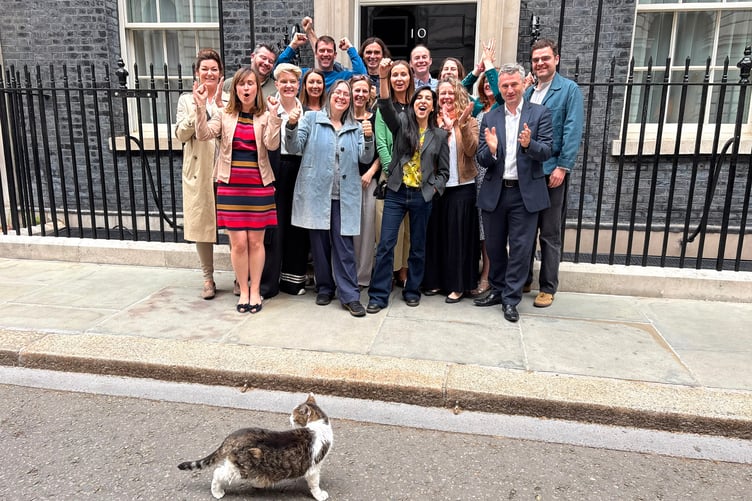
Farnham parents have taken their campaign for a smartphone-free childhood to No 10 Downing Street after helping drive calls for a minimum social media age of 16.
Roz Maree of Farnham was among local Smartphone Free Childhood representatives invited to Downing Street for the Government’s announcement backing tougher restrictions on social media use by children.
The visit marked a significant moment for a movement that has gathered momentum across Farnham , where parents, schools and community groups have been working together to reduce children's exposure to smartphones and social media.
Campaigners say the constituency has become one of the most active in the country, with residents contacting their MP in large numbers to support a minimum social media age of 16.




Ms Maree attended the No 10 event alongside other regional Smartphone Free Childhood leaders.
She said: "Ordinary parents spoke up, with our cause supported by fantastic local community leaders. We helped change the national conversation.
“It's exciting to see proof that ordinary people can still shape the future their children grow up in. It's not a silver bullet but it changes the direction of travel. It's a clear signal that childhood matters, and that the wellbeing of children is more important than the commercial interests of technology companies."
Support for the movement has continued to grow across Surrey, with 10,995 parents signing the Smartphone Free Childhood Parent Pact, placing the county at the top of the national leaderboard.
The pact encourages parents to delay giving their child a smartphone until at least age 14, helping families resist the pressure that comes when children believe "everyone else has one".
Locally, the campaign has organised a series of PAPAYA talks — Parents Against Phone Addiction in Young Adults — with support from Farnham Town Council community grants.
Events have been held at St Polycarp's, Potter's Gate, William Cobbett, St Peter's and Rowledge primary schools, with some attracting packed audiences as families discussed the impact of smartphones and social media on children's wellbeing.
The campaign has also featured at the Farnham Sustainability & Wellbeing Festival and the Farnham Literary Festival, where TJ Power and Dr Martha Deiros Collado discussed the effects of "Digital Overload" on children.
Campaigners say the conversation is now leading to action in local schools.
All Hallows has confirmed it will introduce a "brick phone only" policy for pupils in Years 7 to 11 from September 2027. The wider Mother Teresa Catholic Trust, including its primary schools, will also adopt the approach.
Meanwhile, Weydon Multi Academy Trust has outlined plans for changes to its phone policy.
The trust said: "In January 2026 the Department for Education (DfE) updated its guidance to schools, shifting from a discretionary approach to a clear expectation that schools should be phone-free by default. Further to this, in April, the government proposed strengthening this by making the ban a legal requirement rather than an expectation."
Following consultation with parents, WMAT headteachers added: "While many parents value phones for safety and GPS tracking during the journey to and from school, there is a striking consensus regarding the inescapable nature of social media, especially when combined with smartphone use.
“The top parental concerns around smartphones include exposure to harmful content, such as radicalisation and misogyny, as well as the negative impact of cyberbullying and doomscrolling on student mental health."
Hundreds of parents have signed a letter thanking WMAT head teachers for prioritising children's wellbeing.
Comments
This article has no comments yet. Be the first to leave a comment.