
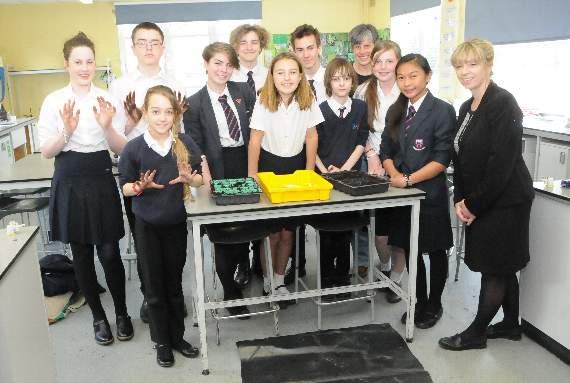
ROCKET science has taken off at two schools in Surrey and Sussex.
In an out-of-this world project involving British astronaut Tim Peake, the UK Space Agency and the Royal Horticultural Society (RHS), pupils from Woolmer Hill in Haslemere, and Fernhurst Primary are taking part in a national experiment. The voyage of discovery involves growing plants from, appropriately, rocket seeds.
Two kilograms of rocket seeds took off from Florida on board Soyuz 44S bound for the International Space Station – as part of Tim Peake’s six-month Principia mission.
After several months on board, the seeds were sent back and landed in the Pacific Ocean in the spring.
They were packaged up with identical seeds that had stayed on Earth.
Woolmer Hill secondary school and Fernhurst Primary are two of some 10,000 schools which received a packet of 100 seeds from space and 100 of the control seeds.
Schools across the UK also received a special video message from European Space Agency (ESA) astronaut Tim Peake.
Tim, who is currently on board the International Space Station, is calling on them to help the RHS with the space food mission.
The idea is to compare the growth of the salad leaves as part of an experiment to see if we can sustain human life in space by growing “cosmic food”.
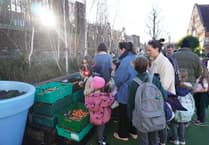
At Woolmer Hill, students spent a lunch break planting and carefully labelling the seeds. The students now have to grow and compare the seeds and to input their results into a national online database so that results can be compared across all schools taking part in the UK.
Results will be collected and analysed by professional biostatisticians and published later this year, feeding into the work going on in space research.
The rocket scientists at Woolmer Hill are being led by science teacher Dr Lucy Whiteman, who also runs the school’s new vegetable garden project. She hopes the experiment will inspire pupils to think scientifically and help them to see the potential of future careers in STEM subjects (science, technology, engineering, maths) and horticulture.
Fernhurst’s year six pupils have also become space biologists by running the experiment. They are will be measuring the differences over seven weeks.
Teachers Mrs Isaac and Mrs Mackey, who are working with the children on the project, said: “We are very excited to be taking part in Rocket Science, particularly as it links to the mission of Chichester astronaut Tim Peake.
This experiment is a fantastic way of teaching our pupils to think more scientifically and share their findings with the whole school.”
• The children have various theories as to what might happen with the seeds and have been working hard looking after them – taking measurements, writing journals about the experiment, taking photos and keeping a log book of quotes and theories.
Pupil Aidan Hewitt thinks the seeds from space will grow more slowly than those which have not left the earth’s atmosphere, as he believes the space seeds will still be recovering from the zero gravity they experienced.
• Tim Peake’s video message shows him in the Columbus module, a laboratory on the space station, which is orbiting the Earth at 1,700mph.
In the broadcast Tim can be be seen with the rocket seeds before they were returned to Earth, visit www.rhs.org.uk and search for ‘seeds in space’.
Comments
This article has no comments yet. Be the first to leave a comment.