
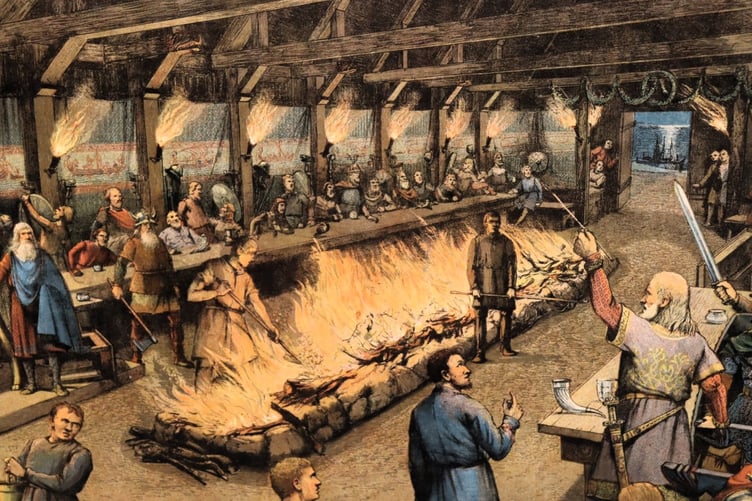
In 893, according to the Anglo-Saxon Chronicle, a large Viking army landed at Appledore in east Kent, having rampaged through northern France and boarded 250 ships at Boulogne, writes Derek Carpenter.
A second flotilla of 80 ships followed, led by King Hastein, landing at the mouth of the Thames. The intention was for both armies to unite and form a single force capable of pillaging wealthy towns across southern England.
By 894, that reunion had not taken place, largely because King Alfred positioned his forces on high ground between the two Viking armies, preventing them from joining.
Some sources suggest the smaller army, led by Hastein, was captured almost in its entirety and “had given oaths to King Alfred, and six hostages”, two of whom were reportedly Hastein’s own children. They were baptised during their captivity.



The Anglo-Saxon Chronicle records that “nevertheless, contrary to the truce” the Danes departed and continued to plunder, having “now seized much booty, and would ferry it northward over Thames into Essex, to meet their ships”.
That planned route back to Essex, heavily laden with stolen valuables, took them through Farnham. There, part of the Anglo-Saxon army, led by Alfred’s son Edward the Elder, lay in wait and routed them.
Roy Waight, in his book Farnham in History, suggests the battle may have taken place near Gong Hill, south of Frensham.
Edward decimated and scattered the remaining Viking force, which retreated north in disarray, abandoning much of the booty accumulated over months of raiding.
What remained of the army was pursued to the Thames and the temporary safety of an island in its tributary, the River Colne. Their ultimate fate is unclear, as the pursuing Anglo-Saxon force was suddenly confronted by the larger Viking army, which was also described as “returning homewards”.
The Battle of Farnham, as it later became known, was a partial but significant victory for the Anglo-Saxons. It did not, however, mark the end of Viking raids in Britain.
Elements of Hastein’s army reached Devon, including Exeter. Others travelled towards Essex and Kent, while a larger group crossed to the east bank of the River Severn before heading north to the Wirral and Chester.
At Chester, they were met by combined Mercian, Welsh and West Saxon forces. Once again, they were defeated, through battle and starvation. Survivors were dispersed across northern England.
Many people today are living proof that the Danes were never entirely driven out. Modern DNA analysis often reveals small but persistent traces of Danish ancestry still present among us.
Derek Carpenter is chairman of the Farnham Castle Trust.
Comments
This article has no comments yet. Be the first to leave a comment.