
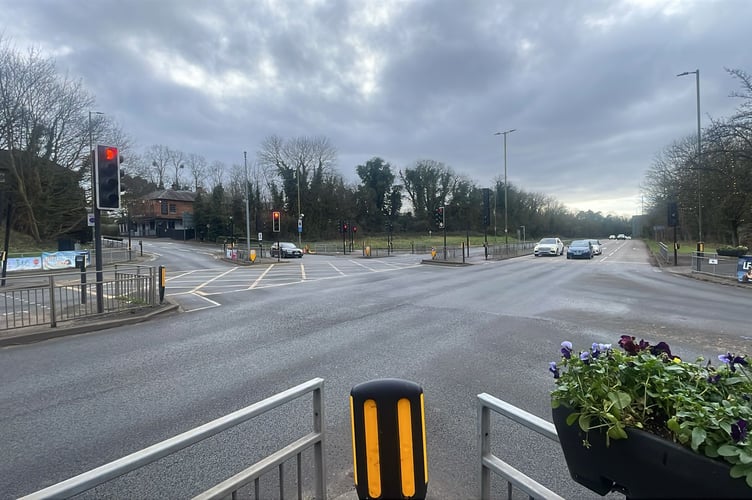
This year began with the sad news of a pedestrian death at Hickley’s Corner on the A31 bypass — and, once again, renewed calls for safety improvements.
For many residents, the debate felt painfully familiar. In fact, campaigners have been arguing about how best to make the junction safe since 1969, when the A31 Committee first began pressing for an underpass at Hickley’s Corner, a solution they believed would protect pedestrians without cutting communities off from the town centre.
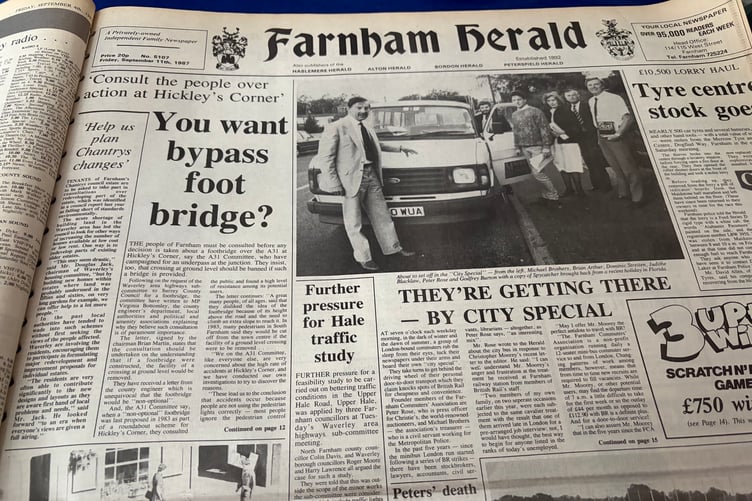
The argument has resurfaced repeatedly ever since. A Farnham Herald front page from September 11, 1987 carried the headline: “You want bypass footbridge: Consult people over action at Hickley’s Corner.”
.png?width=209&height=140&crop=209:145,smart&quality=75)
.jpeg?width=209&height=140&crop=209:145,smart&quality=75)
The article described the work of the A31 Committee, which was still campaigning for an underpass following fresh proposals for a pedestrian footbridge.
Under chairman Brian Martin, the committee wrote to then MP Virginia Bottomley, county engineers and local authorities urging proper consultation before any decision was taken about the bridge.
Calls for a footbridge had stretched back to at least 1983, when plans for a roundabout at Hickley’s Corner were first considered.
At the time, a proposed non-optional footbridge met strong opposition from potential users. The committee reported that many people of all ages disliked the idea because of its height above the road and the extra climb required to reach it.
Residents in South Farnham also feared losing easy access to the town centre if the ground-level crossing disappeared, saying they would feel cut off.
Concerned by the high number of accidents, the A31 Committee carried out its own investigations. The pedestrian signals, they argued, were confusing and did not clearly indicate when it was safe to cross.
The committee also opposed the view of county highways engineers, who, they said, “seem to see pedestrians as being at fault in the failure of the control system to provide adequate protection, rather than the system itself.
“We consider this unjust, as the system itself is genuinely confusing.”
In response, the county engineer stated that pedestrians were unwilling to wait for the green man or felt unable to judge safely when crossing the busy A31.
“If the signals were followed implicitly, pedestrians could cross in relative safety,” the report said.
Residents were asked whether they preferred a footbridge without a road crossing, both options, or the crossing alone. No bridge was ever built, suggesting public opinion favoured keeping the crossing at ground level.
The A31 Committee maintained its long-held position. While a footbridge was seen by some as inevitable, members insisted safer alternatives existed, echoing the campaign they had begun decades earlier.
“Improvement of this difficult road junction should benefit all its users,” they wrote. “Only an underpass can do that.”
Decades later, the debate continues, a reminder that the safety question at Hickley’s Corner has been running for generations.
Comments
We've recently changed our login process. If you have an account for commenting, you will need to re-register on the login window.
This article has no comments yet. Be the first to leave a comment.