
An undercover British agent, with the code 007, captured by the secret police and heading for an unknown fate.
This was not the plot of a James Bond spy thriller but reality in the final weeks of the Second World War, when Hugh Falconer of the Special Operations Executive (SOE) was being escorted under Gestapo guard alongside theologian and anti-Nazi resister Dietrich Bonhoeffer.
This episode forms the dramatic backdrop to a new book exploring an extraordinary episode involving Bonhoeffer and Falconer, a British secret agent whose true identity remained hidden for decades.
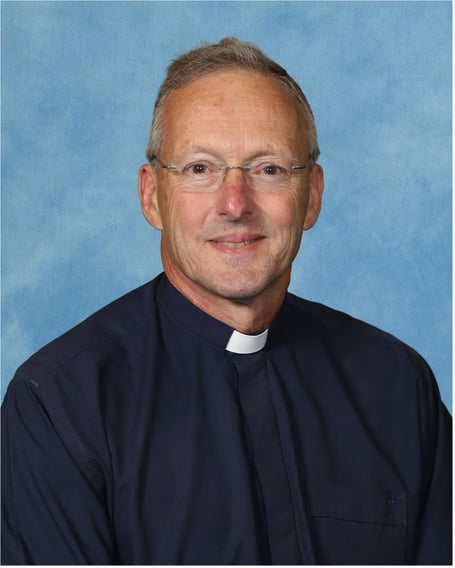
Their story has been uncovered through research by the Rev John McCabe, who retired last year from his role as rector of St Mary’s Church in Byfleet.


In his new book Dietrich Bonhoeffer:The Last Eight Days, Mr McCabe explores the heroism of Bonhoeffer in the days before he was executed by the SS at Flossenbürg concentration camp.
By early 1945, Nazi Germany was collapsing, but the violence of the war showed no sign of easing. Across Europe, refugees were fleeing advancing armies, London was still under attack from German rockets and death marches of concentration camp prisoners were spreading misery across the continent.
Against this bleak setting, the small police van known as a Grüne Minna left Buchenwald under Gestapo guard carrying a group of VIP prisoners, including Bonhoeffer and Falconer.
Bonhoeffer had opposed Hitler’s regime since 1933 and was arrested for his involvement in resistance activity. He would be executed just weeks before the war ended. The new book reveals for the first time how Falconer, later identified as SOE Agent 007, carried out a daring act of sabotage in April 1945 that almost saved Bonhoeffer’s life.
Mr McCabe said the idea for the book had been with him for many years, but the research intensified during a sabbatical in April 2017.
“We were staying with friends in Brisbane and after a conversation over breakfast I felt challenged to write the book,” he said. “The next morning I went straight to Brisbane library and began researching the 12 people who were in the police van with Bonhoeffer during the last week of his life.”
An initial online search proved sobering, with only four of the 12 prisoners producing any meaningful results.
“It was immediately obvious this was going to be a long-term project,” he said.
In fact, an early draft titled Bonhoeffer’s Final Journey dated back to 2005. The author’s interest was further fuelled in 2013 when his family passed on an original copy of Mein Kampf, signed by Nazi official Arthur Seyss-Inquart and later discarded when Canadian intelligence cleared a Gestapo office in 1945.
Research trips followed, including a visit to Schönberg in Bavaria, where Bonhoeffer spent his final days.
“I arrived with almost nothing to go on and felt they rolled out the red carpet for me,” Mr McCabe said.
After two years, he was awarded $4,000 in research funding by the International Bonhoeffer Society and became a research associate at Cambridge University’s Von Hügel Institute. Even then, progress was slow.
“I spent four to six years searching for material that simply didn’t exist,” he said. “That included making contact with journalists in other countries and chasing leads that went nowhere.”
Some of the most significant breakthroughs came through Greek and Russian sources, including a meeting in London arranged through a Russian contact that led him to a private Holy Communion service in the crypt of Westminster Abbey.
A newly published source book, The Gestapo’s Most Improbable Hostage, also proved invaluable.
One of the most moving moments came when Mr McCabe made contact with Falconer’s daughter in Liverpool.
“It was an absolute privilege to interview someone whose father was actually there in the van with Bonhoeffer, almost 80 years after the events,” he said.
Further research into the SOE led to unexpected discoveries, including a 1939 photograph of Bonhoeffer aboard the SS Bremen, with future SOE agent Pippa Latour visible in the background. Through an SOE writers’ network, Mr McCabe contacted Latour, who was living in New Zealand in 2020.
“She confirmed it was her in the photograph,” he said. “That connection meant a great deal to people in Byfleet during Remembrance events.”
Writing the book was balanced alongside parish life, with Mr McCabe choosing not to publicise the project too widely within his congregation.
He retired in the summer of 2024, bringing the long-running project to completion.
The book is published by Baylor University Press, with a German-language edition published by Penguin.
It is now available at a special News & Mail price of £20 (normal price £36). Copies can be reserved using the code last8 at: mngbookshop.co.uk/9781481321679/dietrich-bonhoeffer-the-last-eight-days/
Comments
This article has no comments yet. Be the first to leave a comment.