
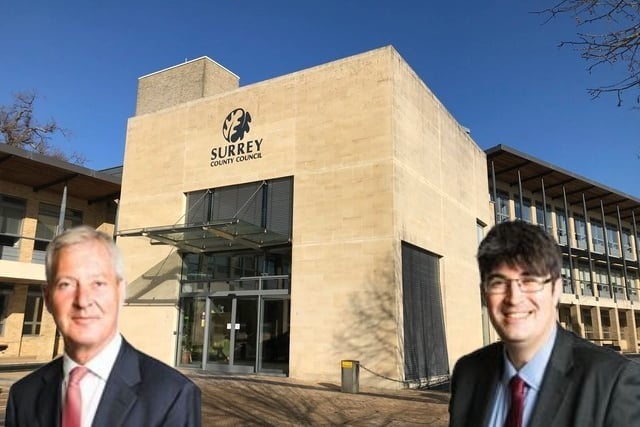
Surrey will press ahead with two long-planned specialist free schools but councillors have admitted the plans will still leave “significant” gaps in provision.
The scheme will unlock £16.14m of government cash to create at least 220 new SEND places.
Cabinet members agreed to move forward with the Department for Education-funded delivery of Betchwood Vale Academy (180 places) and Frimley Oak Academy (170 places), rather than take a combined £18.9m cash alternative to build provision themselves.
At the same time the Surrey County Council will accept £8.1m, in place of a third planned SEMH free school, and use the money to create 150 places through other local projects.


The decisions are aimed at tackling mounting pressure on Surrey’s specialist system, where public special schools are running at 103 per cent capacity.
Cllr Helyn Clack, cabinet member for Children, Families and Lifelong Learning, said the move would “accelerate projects that directly benefit Surrey families within months, not years”.
She told the meeting: “We know families can face long delays, longer journeys and too many children placed in independent settings, often far from home, simply because we do not yet have the places available locally.”
Scrutiny members warned that the expansion will not fully solve the problem. Cllr Catherine Powell, chair of the children’s select committee, told cabinet there is a current shortfall of more than 120 autism (ASD) places in West Surrey alone.
She urged the authority to publish clearer mapping of unmet need, including where children are still waiting for placements and where non-maintained independent (NMI) schools are being used.
“There is a clear shortage of special school places and SEND units today in Surrey,” she said, adding that the new projects “do not address all of the current unmet need which is still significantly higher in the West”.
Councillors acknowledged that even with the additional 220 places funded through the High Needs Provision Capital Allocation, plus the 350 places from the two free schools, “significant numbers” of children will still be without local specialist provision.
Council leader Tim Oliver said while the SEND expansion would not “fill all our gaps”, it was vital to proceed with deliverable projects now.
“We absolutely need to get on with as many of these projects as we possibly can, to create 350 new places is desperately needed, and even that will leave a significant number of children without a place,” he said.
The 220 places are expected to come forward through a mix of expanded special schools, new units in mainstream settings and alternative provision projects. The council says priority has been given to schemes that can open for September 2026.
The backdrop is sustained growth in Education, Health and Care Plans (EHCPs) and heavy reliance on independent placements, which are typically more expensive and often outside the county. Expanding state-maintained provision is seen as key to reducing those costs and meeting Surrey’s “safety valve” agreement with the DfE to contain its SEND deficit.
Geography remains a sticking point. While overall provision is broadly aligned with population split between East and West Surrey, members accepted that unmet need, particularly for Autism Spectrum Disorder (ASD), is currently greater in the West. Leaders said the £8.1 million accepted in lieu of the cancelled Social Emotional Mental Health (SEMH) free school would be ring-fenced while further site work is carried out.
The council must formally notify the Department for Education of its decision on the free schools by the end of the week.
Comments
We've recently changed our login process. If you have an account for commenting, you will need to re-register on the login window.
This article has no comments yet. Be the first to leave a comment.