
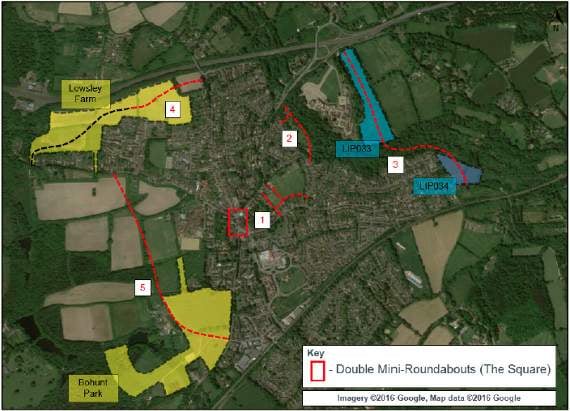
EAST Hampshire District Council has published the long-awaited phase two of the Liphook Transport Feasibility Study, to help understand the current traffic flows through the centre of the village.
The study concluded a significant proportion of traffic travelling through the double mini-roundabouts is not strategic traffic – so a revised signage strategy is not warranted.
The Atkins report was commissioned by Hampshire County Council, on behalf of EHDC and outlines the proportion of traffic considered ‘local,’ with the origin or destination within the parish or external, and ‘non-local’ traffic passing through Liphook.
It has subsequently been used to assess the viability of a series of relief road options identified in phase one, undertaken in 2016, which concluded the double mini-roundabouts in The Square were experiencing capacity issues and would further exceed capacity by 2021, when the already approved new housing developments were completed.


-Amber-warning-for-cold-weather.png?width=209&height=140&crop=209:145,smart&quality=75)
The phase two study identified more strategic reduction plans with the aim of reducing the volume of vehicles travelling through the vilage centre at peak times.
It recorded the number of vehicles, associated with dropping-off or picking-up pupils from Liphook Infant and Junior School as well as at Bohunt – whether the journey started within our from outside the village.
A traffic survey was undertaken by Atkins in 2017 to determine traffic flows through Liphook and the double mini-roundabouts.
To determine the origin and destination of all traffic travelling through the village centre, a series of automatic number plate recognition cameras (ANPR) were installed at Longmoor, London, Haslemere, Headley, Midhurst, Portsmouth, Station and Church roads.
The ANPR cameras recorded number plates at specified locations by time and date, which enabled Atkins to construct a vehicle movement and journey time matrix for a specified study area.
The predominant movement recorded during the surveys for the morning and evening peak period suggested traffic from Whitehill and Bordon accesses and exits the A3 via Liphook, instead of the A325 at Longmoor, which may reflect congestion at the Longmoor junction, while the majority of vehicles entering and exiting Liphook during the same periods come from Headley and London roads.
The report concluded a high proportion of traffic travelling through Liphook at peak times, particularly at the mini-roundabouts, is local traffic and most vehicles dropping-off and picking-up children access and exit the schools via the Headley Road.
The study claimed none of the strategic relief options proposed in the report would accommodate the predominant movements recorded during the surveys for morning and evening peak times.
The report recommends a further assessment is undertaken on the double mini-roundabouts in The Square, including the pedestrian crossing, to understand the possible relief if traffic is removed from the network with sustainable transport options, initiatives by schools and work places, travel planning, promoting cycling and walking and discouraging driving.
The five options include two new routes for a relief road which would skirt around the eastern side where a number of developments have been suggested.
See right for full details.
Comments
This article has no comments yet. Be the first to leave a comment.