
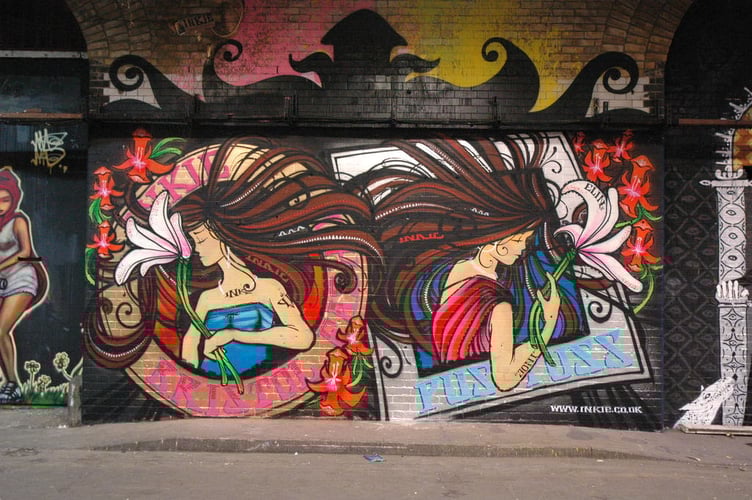
Tate Britain and Tate Modern art guide and lecturer Raymond Warburton opened our eyes to the rise and development of street art in Britain. Originating in the United States in the early 1970s, graffiti first appeared on the trains and subways of New York as a counter-cultural creative outlet for poor Black and Latino youth. It arrived in Britain through the influence of the film Style Wars and books such as Subway Art and Wild Style, and its impact was immediate. Hip hop, street dance, and punk pop all erupted onto the streets at roughly the same time, shaping a powerful new visual and musical culture.
Although the terms street art and graffiti are often used interchangeably, Raymond explained that there are clear distinctions. Graffiti tags are stylised signatures or monikers of the “artists” themselves. Graffiti messages may be personal, political, or humorous expressions. Street murals, however, go far beyond graffiti: they are often large-scale, visually striking works with clear artistic ambition and pretensions to being “fine art”.
Spray-can paint became the street artist’s tool of choice due to its acrylic base and quick-drying properties. Bristol is widely regarded as the birthplace of street art in the UK and as the home of artists such as Banksy (purportedly Robin Gunningham and/or John Nation), Inkie (Tom Bingle), and Jody (Jody Thomas). All have gone on to achieve national and international recognition, transitioning from illicit street work to legitimate projects commissioned or approved by councils across Britain.
Since the 1980s, street art festivals have emerged nationwide, with Bristol’s Upfest – now the largest in Europe. Councils increasingly use street art as a tool for regeneration, allowing artists to revitalise neglected urban spaces, such as London’s Leake Street Tunnel in 2018.

.jpeg?width=209&height=140&crop=209:145,smart&quality=75)


A new generation of street artists and graffiti writers continues to make its mark, including STIK, My Dog Sighs, Artista, and Annatomix. Yet public opinion remains divided: 34 per cent believe all graffiti is vandalism, while 58 per cent feel some of it is acceptable. In this context, Banksy’s observation that “Art should comfort the disturbed and disturb the comfortable” feels particularly apt.
Our next lecture on Thursday, February 5 in Grayshott Village Hall is at 2pm is “The Founders and Treasures of the Wallace Collection” by Stephen Duffy. For more information see www.theartssocietygrayshott.org or phone Niamh on 07984458869.
By Liz Beecheno
Comments
We've recently changed our login process. If you have an account for commenting, you will need to re-register on the login window.
This article has no comments yet. Be the first to leave a comment.