
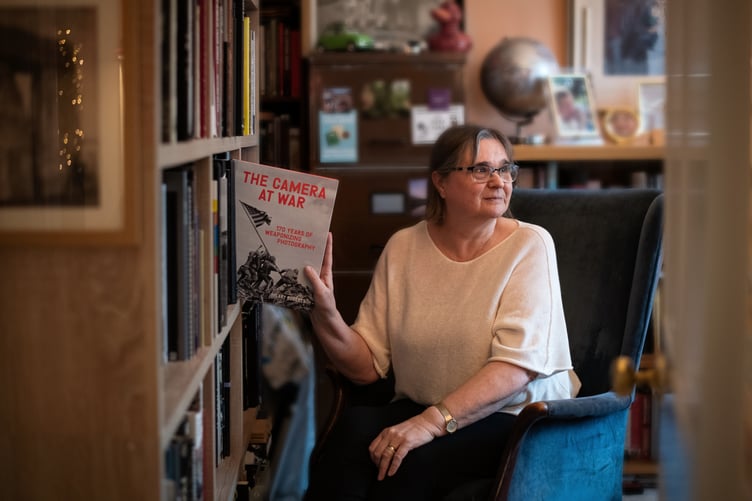
A local authority on war photography has released a new book exploring how images of conflict shape public understanding of truth.
Hilary Roberts, a curator and historian with a long career at Imperial War Museums, has published Camera at War: 170 Years of Weaponizing Photography, her fifth major book.
Over a career spanning more than 45 years, she has played a central role in shaping how war photography is collected, researched and presented to the public.



The book draws on decades of professional experience and close engagement with one of the world’s most important photographic collections. At its core is a challenging question: how images of war influence what people understand as truth.
Roberts joined Imperial War Museums’ Photograph Archive as a junior curator in 1980, at a time when attitudes to photography in museums were changing.
“It was an exciting time for photography,” she said. “Museums and galleries were beginning to recognise that photographs had value not only as art, but as historical artefacts, yet the profession of photo-curatorship was still in its infancy.”
Her academic background in modern history, languages and archive science, studied in the UK and Europe during the 1970s, helped shape her approach as a curator and historian.
A formative moment came during a visit to Prague in 1977.
“I saw an open-air exhibition that made me realise photographs have a unique ability to transcend language barriers and communicate on many different levels,” she said. “From that moment, I was drawn to photography.”
The idea for Camera at War grew out of her long-standing interest in the complex relationship between conflict photography and truth.
“I have always been interested in the complicated relationship between conflict photography and the idea of ‘truth’,” she said. “In recent years, advances in digital technology have made us question whether photographs of war and conflict can ever be trusted.”
She said ongoing conflicts, including those in Ukraine and the Middle East, had made the subject increasingly urgent.
“I wanted to explore the subject in a way that stimulates readers’ awareness, understanding and curiosity,” she said.
Reflecting on her career, Roberts said the field had changed significantly, with shifts in technology, the nature of conflict and audience expectations.
“Today’s audiences are far more diverse, inclusive and sophisticated, with higher expectations,” she said. “What hasn’t changed is the need to understand conflict and its impact on our lives. Photography is still there to help us do that.”
The book traces the use of photo-manipulation in war imagery from the Crimean War to the present day, drawing on material from Imperial War Museums’ collections and major archives around the world.
Camera at War: 170 Years of Weaponising Photography is published by Ilex Press in collaboration with Imperial War Museums.
Comments
This article has no comments yet. Be the first to leave a comment.