
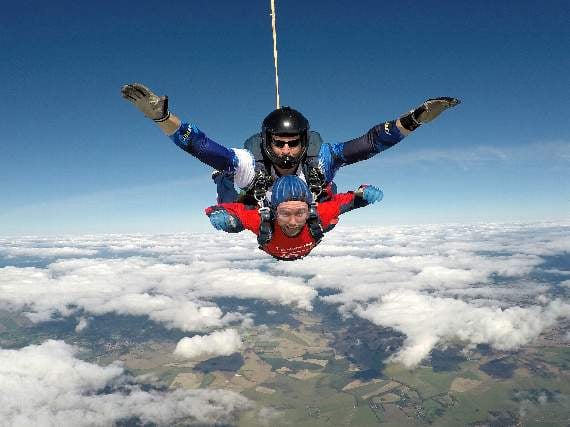
THE VIEWS from 13,000ft above Salisbury Plain are quite stunning.
Although plummeting at speeds in excess of 120mph, the views don’t last that long!
The reason I was taking on the terrifying skydive was to help raise money for Phyllis Tuckwell Hospice.
The Herald has been raising funds for the hospice throughout this year to celebrate its 40th anniversary.
Several Herald staff have taken on challenges to raise funds for the hospice and I, perhaps foolishly, put my hand up for the skydive.
The thought of jumping out of a plane at 13,000ft was somewhat terrifying, but I was happy to take this on for such a good cause.
As soon as I arrived at the Netheravon Airfield I was immediately put at ease by the professionalism of the Army Parachute Association staff.
The day started with training with my instructor Billy, who did the tandem skydive with me. He was very thorough and explained what I would need to do and when. While he would be pulling the parachute, there were still several important steps I needed to get right during the jump.
As I would be in front of Billy I would be the first person out of the plane. He explained I would need to have almost my whole body outside the plane, with just the end of my backside still on the plane. I also needed to cross my legs together and tuck them back, almost below the plane.
Billy also explained I would need to have my hips forward, head back and arms tucked in for the jump to keep a strong core. After a few seconds he would tap me on the shoulder and I would be able to put my arms out.
During the training Billy also explained how the parachute would work. He would open the parachute, but if, for whatever reason, it wouldn’t open, there was a reserve parachute he would open. If he was unconscious and unable to open the parachute, there was a computer in the parachute which would open it once we were a certain distance from the ground.
Billy explained the landing was the most important part of the jump. I would need to lift my legs out the way to give him the room to complete the landing. If my legs were down I would be landing first, and as I had no previous skydiving experience the risk of injury, such as a broken leg, was quite high. At the end of the training I was tested to check I could hold my legs up for 15 seconds, and thankfully I passed the test with flying colours.
At the last minute I was bumped up a flight, but Billy checked all my straps and put me at ease and made sure we were all good to go. The best way to describe all the strapping and equipment would be snug. I felt completely secure and there was no way I would be falling out the equipment.
We got on the plane and were sat at the back, and were packed in like sardines with about 15 people tightly squeezed into the plane. Most of the others were Red Devils on training jumps, and they got out the plane at 6,000ft. Billy and I remained, though, and headed up to 13,000ft.
When it came to the jump I was concentrating on carrying out what I had done in my training; crossing my legs together and tucking them back, and having my hips forward, head back and arms tucked in. Put it this way, the look of concentration on my face on the video footage of the jump is quite something!
The jump was like nothing I have ever experienced before. At 13,000ft the temperature was several degrees below freezing, although I didn’t notice that travelling at speeds in excess of 120mph!
For the first few seconds it didn’t really hit me what was happening. I then got the tap from Billy to open my arms and the speed and force of the jump finally hit home. The force of the air and wind hitting me was truly incredible. After a precise 46 seconds Billy deployed the parachute and the freefall part of the descent was over.
Once the parachute was deployed, the change in the descent was remarkable. After the speed, power and noise of the freefall descent, suddenly it was almost completely silent as we glided around. It was so peaceful and tranquil – it was almost like there was nobody else in the world.
It’s safe to say I’ll never forget my skydiving experience, and I must thank everyone at the Netheravon Airfield and the Army Parachute Association. It was also great to help raise money for Phyllis Tuckwell Hospice.
The Herald’s JustGiving page has raised more than £1,150 for the hospice, and is still accepting donations. Visit www.justgiving.com/fundraising/heraldhospiceappeal to make a donation.
Comments
This article has no comments yet. Be the first to leave a comment.