
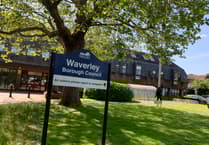
WAVERLEY borough has been placed fourth in a league table of the best places to live in the country and East Hampshire district is 16th.
The annual Halifax rural quality of life survey found that residents of South Oxfordshire enjoy the best quality of life of any rural area in Great Britain.
Second is the Chilterns and last year’s winner, Rutland, is Britain’s third most desirable rural place to live.
Waverley was ranked sixth last year and East Hampshire is up 35 places to 16th.


The Halifax Rural Quality of Life Survey tracks where living standards are highest in Great Britain and covers data including the labour market, the housing market, the environment, education, health and personal well-being.
The survey is based on data at local authority district (LAD)level and examines all 121 rural LADs in Great Britain.
Other sources are the Halifax Building Society, Point Topic (Broadband data), ONS, DEFRA, the Met Office, the Department for Transport, Department of Children, schools and families, the Department of Energy and Climate Change, the Welsh Assembly, and the Scottish Executive.
Craig McKinlay, mortgages director at the Halifax, said: “Having scored strongly across a wide range of economic, environmental and social factors, residents of South Oxfordshire can now lay claim to having the highest standard of living in rural Britain.
“Many of the towns in the top 20 are either within commuting distance to the capital or another major city.”
The highest weekly average earnings are in the Chilterns (£912 per week), followed by Waverley (£873 p/w) and South Oxfordshire (£863 p/w).
The national average is now £633 per week, up from £623 last year.
Households in 80 per cent of LADs have access to superfast broadband, i.e. where download speed is greater than two megabits per second (Mbps).
Across all areas of Britain the majority of households have a good level of broadband access - the survey states a download speed of two Mbps is regarded as the minimum for good broadband service.
The proportion of adults (16+ years) with the highest level of qualification gained (such as a degree, NVQ level four and above, or professional qualification) is the highest in the Chilterns (55 per cent), followed by Waverley and Rushcliffe (both 54 per cent) – all significantly above the national average of 35.6 per cent.
Comments
This article has no comments yet. Be the first to leave a comment.