
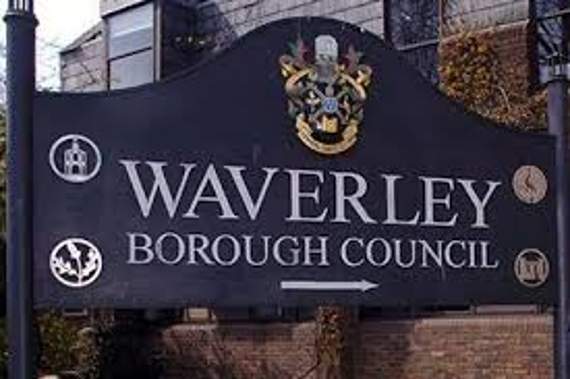
CAMPAIGNERS challenging Waverley’s ‘unsustainable’ housing target to build 11,200 new houses by 2032 in the High Court next month, have been urged to drop their legal cases.
A war of words erupted this week in the run up to the two-day court hearing scheduled for October 9 and 10, after Protect Our Waverley (POW) chairman Bob Lees fired off an open letter to council chief executive Tom Horwood, protesting about the £300,000 of taxpayers’ money it has set aside to defend its Local Plan.
POW and Surrey Campaign to Protect Rural England (CPRE) were given permission in July to challenge Waverley Borough Council’s decision to take 50 per cent of Woking’s unmet housing need, amounting to around 1,500 extra houses.
The Secretary of State’s decision to grant outline planning consent on appeal for 1,800 homes at Dunsfold Park – a cornerstone of the Local Plan – will also be subject to further legal review.



Mr Lees said: “POW and council tax payers are asking why Waverley is wasting so much money defending the challenges from CPRE and POW, which if successful will reduce the housing requirement for the whole of the borough.
“Yes, of course, more houses are needed. But why should Waverley take Woking’s overspill?
“Reducing the housing requirement will relieve the pressure to build in green fields and at unsustainable locations, putting pressure on Waverley’s already overstretched infrastructure. Waverley BC has budgeted £200,000 for the defence of the S113 claims.
“Yet nowhere in their meetings has Waverley considered the ‘do nothing’ option – not defending POW and CPRE challenges.
“Furthermore the borrough voted to allocate £100,000 to defending the S288 challenge to the Secretary of State, despite only being an interested party.
“Again, the council appears to have blindly signed up to this money, without considering the ‘do nothing’ approach.”
Strongly rebutting the charges in an open letter to POW in response, Mr Horwood objected that ‘doing nothing’ was simply not an option and legal costs could be avoided if POW and CPRE dropped their cases.
Mr Horwood said: “The Local Plan was adopted in February by the full council, following years of public consultation and a public examination by the Government’s inspector, who found that it conforms to the National Planning Policy Framework.
“A sound, adopted Local Plan helps the council to reject or approve planning applications in the most sustainable way possible while conforming to government policy. The absence of a Local Plan – which would result from your suggestion that the council ‘do nothing’ – would weaken substantially the council’s ability to defend the area from poor development, while housing demand continues.
“It would also lead to more planning appeals by developers costing substantial amounts of taxpayers’ money. Therefore, the council debated in an open meeting and decided to defend the plan and the borough. The best way to avoid the expense would be for your company, and for CPRE Surrey, to stop your legal cases.
“I hope you will reconsider your legal action.”
Surrey CPRE director Andy Smith said: “This is a nationally important case with far-reaching consequences. The key issue for CPRE is whether a borough such as Waverley, with significant constraints on growth – caused by the designation of the Surrey Hills area of outstanding natural beauty (AONB), areas of great landscape value (AGLV), metropolitan green belt and countryside beyond the green belt – should be forced to accept an arbitrary increase in its housing numbers in order to meet the ‘unmet need’ of another borough.
“This is a nationally important case with far-reaching consequences. The 1,500-plus additional houses would have nowhere to go but in ‘protected’ AONB countryside, and this is surely unacceptable.
“In our view, the housing targets being imposed on Waverley – and Woking and Guildford – are excessive and unsustainable and made more so by the Inspector’s decision to add these ‘uplifts’ to the borough’s housing target without considering the impact on the Surrey Hills.
“We look forward to the opportunity to present our arguments fully in court when the time comes.”
Comments
This article has no comments yet. Be the first to leave a comment.